Last updated June 30, 2026
Garage Door Repair Maintenance Checklist for Delray Beach Homeowners
Here’s something most homeowners don’t expect to hear: the number-one reason Henry Johnson gets called out for emergency repairs in Delray Beach isn’t a spring that snapped without warning — it’s a problem that was visible six months earlier and quietly got worse. Salt air off the Atlantic, summer humidity that parks itself above 90% for weeks at a stretch, and heat that regularly pushes hardware to its limits create a failure environment unlike anything you’d find in a northern climate checklist. This guide is built specifically for Delray Beach doors, Delray Beach weather, and the exact failure patterns we see on service calls in this market.
Quick Answer
A complete garage door maintenance checklist for Delray Beach homeowners covers monthly visual inspections, quarterly lubrication with a heat-stable lubricant, annual spring and cable checks, and a focused hurricane-prep window every April and May. Because South Florida’s salt air and year-round heat accelerate corrosion and lubricant breakdown far faster than in other climates, Delray Beach doors need more frequent attention — not less — than the standard “twice a year” advice you’ll find on generic checklists.
Table of Contents
- Why Delray Beach Is Different: The Climate Factor
- The Monthly 15-Minute Checklist
- Quarterly Lubrication: What to Use (and What to Avoid)
- The Seasonal Maintenance Calendar: Month-by-Month
- Springs and Cables: How to Spot Trouble Before It Snaps
- The 5-Second Balance Test
- Hurricane Prep for Your Garage Door
- Common Mistakes to Avoid
- When to Call a Professional
- Frequently Asked Questions
- The Bottom Line
Why Delray Beach Is Different: The Climate Factor
Pull up any national garage door maintenance guide and you’ll see the same advice: lubricate in spring, check weatherstripping in fall, inspect springs once a year. That schedule was written for Minneapolis. It doesn’t hold up in Delray Beach.
Three forces work against your garage door hardware here that simply don’t exist in most of the country:
- Salt air corrosion: Homes east of Federal Highway — and especially anything within a mile of the Intracoastal or the beach — experience measurable salt deposition on metal hardware year-round. Springs, cables, hinges, and bottom brackets begin surface oxidation faster than the calendar suggests they should.
- Heat-driven lubricant failure: When your garage sits in 95°F heat for five months straight, cheap spray lubricants — particularly anything with a silicone or petroleum base not rated for high heat — thin out, drip off the springs, and leave bare metal before you realize the protection is gone.
- Storm-season stress cycles: Tropical systems and afternoon storms from June through November create rapid pressure changes and wind loads that cycle garage doors hard. Every opening and closing under storm conditions stresses springs, cables, and the door’s structural integrity more than a calm-weather cycle does.
In neighborhoods like Tropic Isle, Delray Lakes, and the barrier island communities along Ocean Boulevard, we see corrosion timelines that run roughly 30–40% faster than national averages. That’s not an estimate — it’s what Henry Johnson has observed across nearly two decades of Delray Beach service calls.
The Monthly 15-Minute Checklist
Fifteen minutes, once a month. That’s the investment that prevents the majority of emergency calls we receive from Delray Beach homeowners. Run through this checklist on the first weekend of each month — it’s fast enough to do during a Saturday morning coffee.
- Listen to the door cycle. Open and close the door completely twice. You’re listening for grinding, scraping, popping, or a labored hum from the opener motor. Any new sound since last month deserves attention.
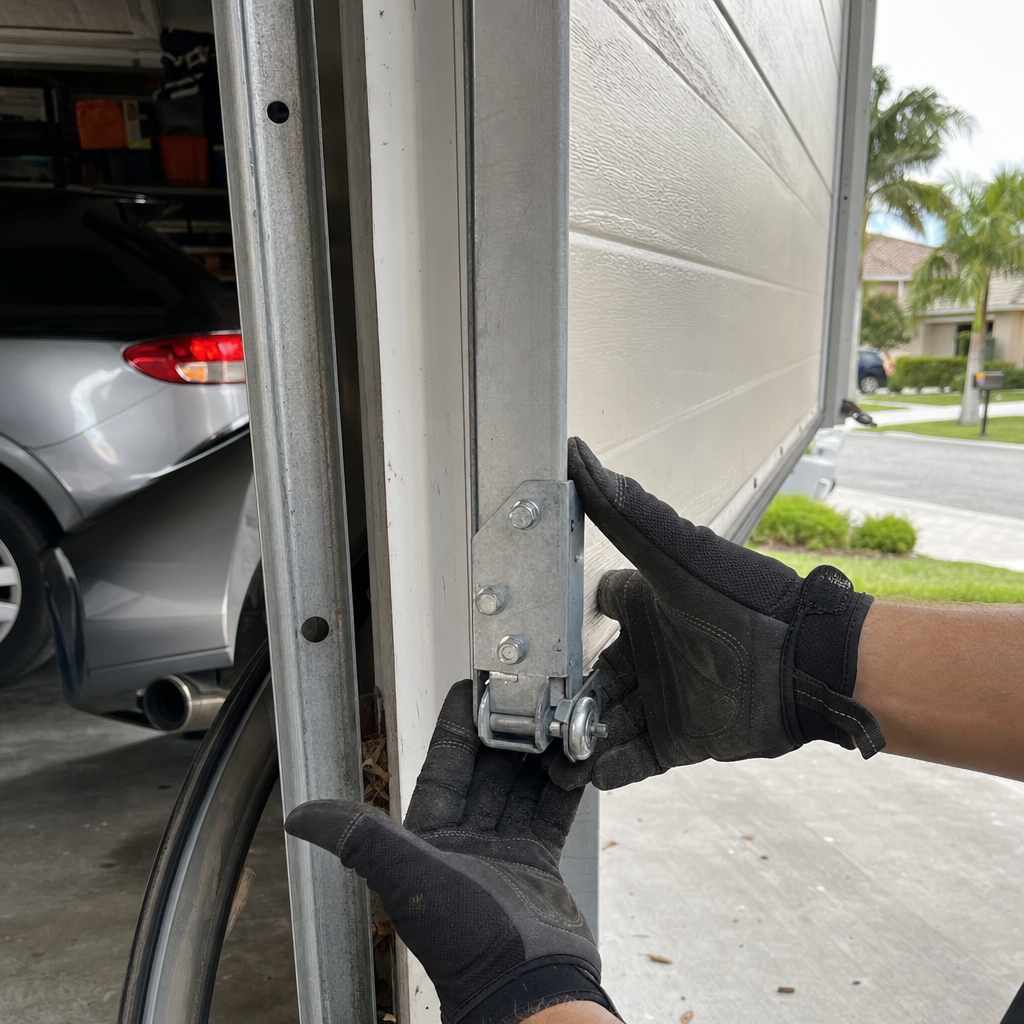
- Check the bottom corner brackets. Stand inside the garage and look at the two brackets where the cable attaches at the bottom corners of the door. Look for frayed cable strands, rust streaking, or any bracket that has shifted position. This is the failure point Henry sees most often on Delray Beach service calls — more on that below.
- Inspect the weatherstripping. Check the bottom seal and the side seals. South Florida’s UV exposure degrades rubber seals faster than you’d expect — a cracked bottom seal lets in water, pests, and humidity that accelerates rust on everything inside the garage.
- Look at the rollers. Rollers should spin freely in the track. Nylon rollers (common on Clopay and Amarr doors) last longer in our climate than steel rollers, but any roller that wobbles, sticks, or shows visible cracking needs replacement before it derails the door.
- Test the auto-reverse safety feature. Place a 2×4 flat on the ground in the door’s path and close the door. It must reverse on contact. If it doesn’t, do not use the door until the opener’s force sensitivity is adjusted — this is a safety issue, not a convenience issue.
- Wipe down the hardware. Use a dry cloth to remove any visible salt residue or moisture from hinges, cables, and springs. In Delray Beach’s coastal air, this one habit alone meaningfully extends hardware lifespan.
Quarterly Lubrication: What to Use (and What to Avoid)
Lubrication is probably the most misunderstood maintenance task for Delray Beach garage doors, because the product that works well in moderate climates can actively harm your hardware here.
Use These
- White lithium grease (aerosol): Rated to stay stable well above 300°F, clings to springs and hinges through heat cycles, and doesn’t drip off in summer. This is our go-to recommendation for torsion springs and metal hinges in Delray Beach.
- PTFE (Teflon-based) dry lubricant: Works well on plastic nylon rollers and the inside of tracks. Doesn’t attract the road dust and garage debris that grease-based products can gum up with over time.
Avoid These
- WD-40 (standard formula): WD-40 is a water displacer, not a lubricant. In South Florida heat it evaporates quickly, leaves a residue that attracts grit, and accelerates rust on bare spring coils. We see the damage it causes on service calls more than we’d like to.
- Standard silicone spray: Thins out dramatically above 85°F and will run off springs and cable drums within weeks in a Delray Beach summer. It also degrades rubber weatherstripping on contact — apply it nowhere near your seals.
- Motor oil or grease from a hardware bin: Heavy petroleum grease collects dust and builds up into a paste that binds moving parts rather than freeing them. We’ve pulled cables off Wayne Dalton and Craftsman doors where previous owners had packed the hardware in motor grease — it’s a labor-intensive cleanup every time.
Where to apply lubricant: Springs (top coils only, not the center shaft), hinges (pivot points only), rollers (the stem and bearing, not the track), and the lock mechanism. Do not lubricate the tracks themselves — clean tracks run better dry, and grease in the track is a common cause of rollers slipping.
The Seasonal Maintenance Calendar: Month-by-Month
The standard “spring and fall” service calendar doesn’t fit a Delray Beach home. Here’s how to distribute your maintenance across the year to match what the climate actually demands.
January – March: Post-Storm Recovery Check
Winter cold fronts and early-season squalls stress door seals and can loosen hardware. Inspect bottom weatherstripping for cracking from brief temperature drops — even our mild winters can degrade older rubber seals. Check all fasteners on the track brackets and confirm the opener’s travel limits are set correctly.
April – May: Hurricane Prep Window (Priority)
This is the most important maintenance window of the year for Delray Beach homeowners. Before Atlantic hurricane season officially opens on June 1, do the following:
- Confirm your door is wind-rated or braced for the wind loads required by Palm Beach County code. Non-rated doors on older homes are a known vulnerability — if your door was installed before 2002 and hasn’t been upgraded, talk to us about what’s required.
- Test all spring tension and cable integrity (see the balance test below).
- Inspect and replace the bottom seal if it shows any cracking — a failed seal during a hurricane allows catastrophic water intrusion.
- Manually disengage the opener and confirm the door can be operated by hand smoothly — you’ll need to do this during a power outage.
- Apply white lithium grease to all metal moving parts before the season begins.
June – August: Monthly Monitoring
Peak heat months. Lubrication degrades fastest here — if you did your April application, check hardware in July for any signs of dryness or corrosion. Keep the garage ventilated where possible; doors in enclosed garages in west Delray Beach neighborhoods like Delray Lakes can see interior temps above 120°F in July.
September – November: Post-Storm Season Inspection
After the active storm season, do a full hardware audit. Check cables for any fraying introduced by repeated hard cycling during storms. Inspect panels for impact damage or warping. October is the best time for your full annual professional tune-up.
December: Year-End Hardware Check
Lubricate before the holiday period when you’re likely to be using the door more. Check the opener battery backup if your unit has one, and test the keypad code.
Springs and Cables: How to Spot Trouble Before It Snaps
This section is important — and we want to be direct about where homeowner inspection ends and professional work begins.
Garage door springs and cables are under extreme tension at all times. A torsion spring holds hundreds of pounds of stored mechanical energy. We don’t recommend that homeowners adjust, remove, or work on springs or cables. What we do recommend is knowing how to spot a problem early so you can call before the spring fails — not after.
What Normal Spring Wear Looks Like
- Slight surface discoloration along the coils after 18–24 months in Delray Beach’s coastal air — this is normal oxidation, not structural failure.
- Minor paint flaking from the center shaft area (this is cosmetic).
- No gaps between coils when the door is fully closed.
What Requires a Professional Call
- A visible gap in the coils when the door is closed — this is a broken spring. Stop using the door immediately. Operating a door with a broken spring puts extreme load on the opener motor and can cause cable derailment.
- Deep rust pitting along the coil surface (not just surface discoloration) — pitting weakens the coil at stress points and significantly shortens remaining life.
- The door feels dramatically heavier when you lift it manually than it did previously — spring tension has degraded.
- Any fraying on the cables at the bottom corner bracket. Even a single strand visibly separated from the cable bundle is a warning sign. In our experience, Delray Beach doors — especially those within a few blocks of the Intracoastal — show cable fraying at this bracket point 60–70% more often than inland doors, due to salt concentration at the cable anchor point.
The 5-Second Balance Test
This is the single most useful quick-check any Delray Beach homeowner can do to catch a spring problem before it becomes a failure. Do it monthly when you run your checklist.
- Close the garage door completely.
- Pull the red emergency release cord to disconnect the opener from the door.
- Manually lift the door to about waist height (approximately 3–4 feet off the ground).
- Let go.
- Watch what happens.
What you’re looking for: A properly balanced door will hold its position — or drift no more than an inch or two in either direction — for at least five seconds. If the door drops toward the floor, the springs are under-tensioned or weakening. If it rises toward the ceiling, the springs are over-tensioned. Either condition means the spring system needs adjustment by a professional.
A door that fails this test is putting extra stress on your opener every single cycle — the motor is compensating for what the springs should be doing. That’s how a spring problem becomes an opener problem, and a $250 spring job becomes a $450 repair.
After releasing the cord, re-engage the opener by pulling the cord toward the door (on most LiftMaster and Chamberlain units) or by pressing the wall button until it re-latches to the trolley carriage.
Hurricane Prep for Your Garage Door
Garage doors are the largest — and statistically most vulnerable — opening on most Delray Beach homes during a hurricane. A door that fails under wind pressure can allow a pressure differential that takes a roof off. This is not an exaggeration; it’s the engineering reality behind Palm Beach County’s post-Andrew building code requirements.
What Every Delray Beach Homeowner Should Know
- Wind-rated doors: If your home was built or the door installed after 2002, it likely meets current wind-load requirements. If you’re unsure, check the door’s hardware label — Clopay, Amarr, and Wayne Dalton all stamp wind-rating data on the door’s interior stile.
- Horizontal bracing kits: For doors that are wind-rated but not impact-rated, a horizontal brace kit adds structural rigidity for the mid-panel span. These can be retrofitted to most single-panel and sectional doors.
- Never use a garage door during a tropical storm or hurricane warning. The opener’s trolley track is not designed for lateral wind load — operating the door in high-wind conditions risks derailment.
- Know your manual release: Power outages are standard during storm events. Every adult in the household should know how to operate the door manually before hurricane season starts, not during it.
- Anchor the locking bar: If your door has a manual slide lock, engage it when the door is closed during a storm. For doors without one, a ground anchor bolt through the track is an option worth discussing with us if you’re in a high-wind exposure zone.
For a full review of your door’s current wind rating and what upgrades may apply to your specific home, our Garage Door Repair in Delray Beach service includes a pre-season structural assessment.
Common Mistakes to Avoid
- Using WD-40 on springs or hinges. We’ve addressed this above, but it bears repeating: WD-40 is not a garage door lubricant. In Delray Beach’s heat, it evaporates fast and leaves hardware worse off than before. Switch to white lithium grease and you’ll see the difference within one service cycle.
- Ignoring a slow or noisy door because it still opens. “It still works” is exactly the reasoning that turns a $180 adjustment into a $600 cable-and-spring replacement. Slow doors and new grinding sounds are early warnings, not normal aging.
- Lubricating the tracks. Grease inside the track attracts debris, causes the rollers to skip, and ultimately makes alignment worse. Clean tracks with a dry cloth — that’s all they need.
- DIY spring tension adjustment. We understand the appeal of fixing things yourself. Springs are the exception. The stored tension in a torsion spring can cause serious injury if released uncontrolled. This is one of the few garage door tasks where the risk-to-reward ratio genuinely favors a professional call every time.
- Skipping the April pre-hurricane inspection. Every June we take calls from Delray Beach homeowners whose doors took preventable damage during the first named storm because the hardware hadn’t been checked since the previous fall. The April window exists for this reason — use it.
- Installing a new opener without addressing the door’s balance first. An opener on an unbalanced door will burn through its motor trying to compensate. If you’re considering a new opener, do the balance test first. Learn more about our Garage Door Opener in Delray Beach services, including pre-installation door assessments.
- Assuming a coastal-adjacent home is “close enough” to an inland maintenance schedule. If your home is east of I-95 in Delray Beach, you’re in accelerated corrosion territory. Monthly checks aren’t excessive — they’re appropriate for your specific exposure level.
When to Call a Professional
Some tasks are straightforward homeowner maintenance. Others cross into territory where experience and the right tools make the difference between a safe repair and a serious injury — or a small fix and a major replacement.
Call a professional when you observe any of the following:
- A visible gap in a spring coil, or a spring that has clearly separated
- Any fraying or unraveling of the lift cables, particularly at the bottom corner bracket
- A door that fails the 5-second balance test
- Panels that are visibly warped, cracked, or have shifted alignment after a storm
- An opener that runs but the door doesn’t move — this usually signals a broken spring, not an opener failure
- Any burning smell from the opener motor during operation
- A door that won’t stay closed or repeatedly reverses for no apparent reason
Patriot Garage Door Solutions Delray Beach offers free estimates and emergency service availability for urgent door failures — Henry Johnson responds personally, not a dispatch crew. Call (754) 240-2374 and you’ll speak to the person who will actually show up.
Frequently Asked Questions
Delray Beach homeowners should lubricate garage door springs, hinges, and rollers every three months — four times per year — compared to the twice-yearly schedule often recommended for northern climates. The combination of salt air, year-round heat, and high humidity breaks down lubricants significantly faster here. Use white lithium grease on metal components and PTFE spray on nylon rollers. If you’re east of Federal Highway or near the Intracoastal, err toward monthly wipe-downs of hardware between full lubrication cycles.
Standard torsion springs are rated for approximately 10,000 cycles — roughly 7–10 years at average use for most households. In coastal Delray Beach, salt air corrosion can reduce that lifespan by 20–30% without consistent maintenance. We regularly see springs on beachside properties fail at 5–6 years when they haven’t been treated with a corrosion-inhibiting lubricant. A spring that’s past the 6-year mark and lives within a mile of the Atlantic deserves a close professional inspection. Call (754) 240-2374 for a free assessment.
Yes — homeowners can and should handle several pre-hurricane tasks: testing the manual release operation, inspecting the bottom seal for cracks, wiping down hardware, and confirming the door moves smoothly by hand. What requires professional evaluation is the door’s wind-load rating, any structural bracing needs, and spring/cable integrity checks. The April–May window we describe in our seasonal calendar above is the right time to get a professional eye on the structural side of hurricane readiness before the season opens.
Repair is almost always the right call when the door’s structure is sound and the issue is isolated — a broken spring, worn rollers, or a failing opener. Replacement makes more sense when panels are significantly corroded, the door was installed before current Palm Beach County wind codes, or repeated repairs are adding up against an aging door. During a free estimate, Henry Johnson will give you an honest read on which direction the math actually favors — there’s no reason to replace a door that has years of reliable service left in it. Call (754) 240-2374 to schedule.
Cable fraying at the bottom corner bracket is the failure point Henry encounters most frequently on Delray Beach doors. The cable anchor at this bracket is where salt-laden moisture collects, where mechanical stress concentrates during every cycle, and where visual access is limited enough that most homeowners miss early warning signs. The second most common issue is dried-out or degraded spring lubrication — doors that were last serviced with the wrong product or not at all in the past 12–18 months. Both are detectable on a monthly 15-minute inspection if you know what to look for.
New garage door installation in Delray Beach typically ranges from $900–$2,800 installed, depending on door material, size, insulation value, and wind-load rating requirements. A standard 16×7 steel single-car door with basic insulation runs at the lower end of that range; a custom wood-look double door with wind bracing and insulated panels can reach the upper range. Palm Beach County’s wind-load requirements add cost compared to some other markets, but they’re non-negotiable for homeowner protection and insurance compliance. Visit our Garage Door Installation in Delray Beach page for a full breakdown, or call (754) 240-2374 for a free in-home estimate.
The Bottom Line
Garage door maintenance in Delray Beach isn’t complicated, but it does require a schedule calibrated to this specific environment — not a generic four-season template. A monthly 15-minute visual check, quarterly lubrication with the right heat-stable product, a focused hurricane prep window every April, and a professional eye on springs and cables at least once a year: that’s the framework that keeps most doors out of the emergency call category. Nearly two decades of Delray Beach service calls have shown Henry Johnson one consistent truth — the homeowners who maintain their doors spend far less over time than those who wait for failure. Start with the balance test this weekend. It takes five seconds and tells you more than most homeowners ever think to ask.
When something does need a professional, Patriot Garage Door Solutions Delray Beach is one call away. Henry Johnson shows up personally, brings 19 years of hands-on experience, and works on virtually every major door and opener brand on the market — LiftMaster, Chamberlain, Clopay, Craftsman, and more. Estimates are always free. Call (754) 240-2374 to schedule a service visit or get a straight answer about what your door actually needs.
Written by Henry Johnson, Owner & Lead Technician at Patriot Garage Door Solutions Delray Beach, serving Delray Beach since 2007.