Last updated June 30, 2026
Seasonal Garage Door Care for Delray Beach: Year-Round Homeowner’s Guide
Here’s something most Delray Beach homeowners don’t expect: the cooler, drier months between October and March are actually harder on garage door hardware than the blazing summer. When temperatures drop at night and humidity falls, metal components contract — and the thin lubrication film that held everything together through a hot, sticky August starts pulling away from the surfaces that need it most. Add in a full wet season’s worth of salt air, rust acceleration on spring ends, and the hydraulic stress of a hurricane prep cycle, and you start to understand why garage doors in South Florida fail on a very different schedule than the one printed in the manual. This guide gives you a maintenance calendar built for Delray Beach’s actual climate — not Ohio’s.
Quick Answer
Seasonal garage door care in Delray Beach means following a three-phase schedule tied to South Florida’s wet season (June–September), dry season (October–March), and pre-storm window (April–May) — not the four-season calendar most manufacturer guides assume. The biggest local threats are salt-air corrosion, humidity-driven wood swelling, summer heat buildup inside sealed garages, and wind-load hardware fatigue from tropical storms. A simple bi-annual inspection plus targeted monthly checks will catch most problems before they become failures.
Table of Contents
- Pre-Storm Season (April–May): Your Most Important Inspection
- Wet Season (June–September): Humidity, Rust, and Heat Damage
- Dry Season (October–March): Recalibration and Lubrication
- Documenting Your Door for Hurricane Season Insurance Claims
- The Summer Habit That Shortens Your Opener’s Life
- Special Considerations for Wood and Wood-Composite Doors in South Florida
- Common Mistakes to Avoid
- When to Call a Professional
- Frequently Asked Questions
- The Bottom Line
Pre-Storm Season (April–May): Your Most Important Inspection
If you only do one thorough garage door inspection per year in Delray Beach, do it in April. By the time June arrives, tropical disturbances are already forming, and discovering a cracked bottom seal or a stripped emergency release cord during an active storm watch is the worst possible timing. April and May are your runway — use them.
A pre-storm inspection has three specific priorities that go beyond a basic tune-up:
- Wind-load hardware check. Florida’s building code requires wind-rated hardware on garage doors — specifically the horizontal and vertical track bracing, the flag angle brackets, and the end stiles. Grab each horizontal track brace and test for flex. If there’s visible bend or the lag screws have backed out of the framing, that’s a code compliance problem and a storm safety problem simultaneously. In older Delray Beach homes — particularly those built before the post-Andrew code revisions took full effect — we regularly find undersized or missing center stiffener bars on doors wider than 16 feet.
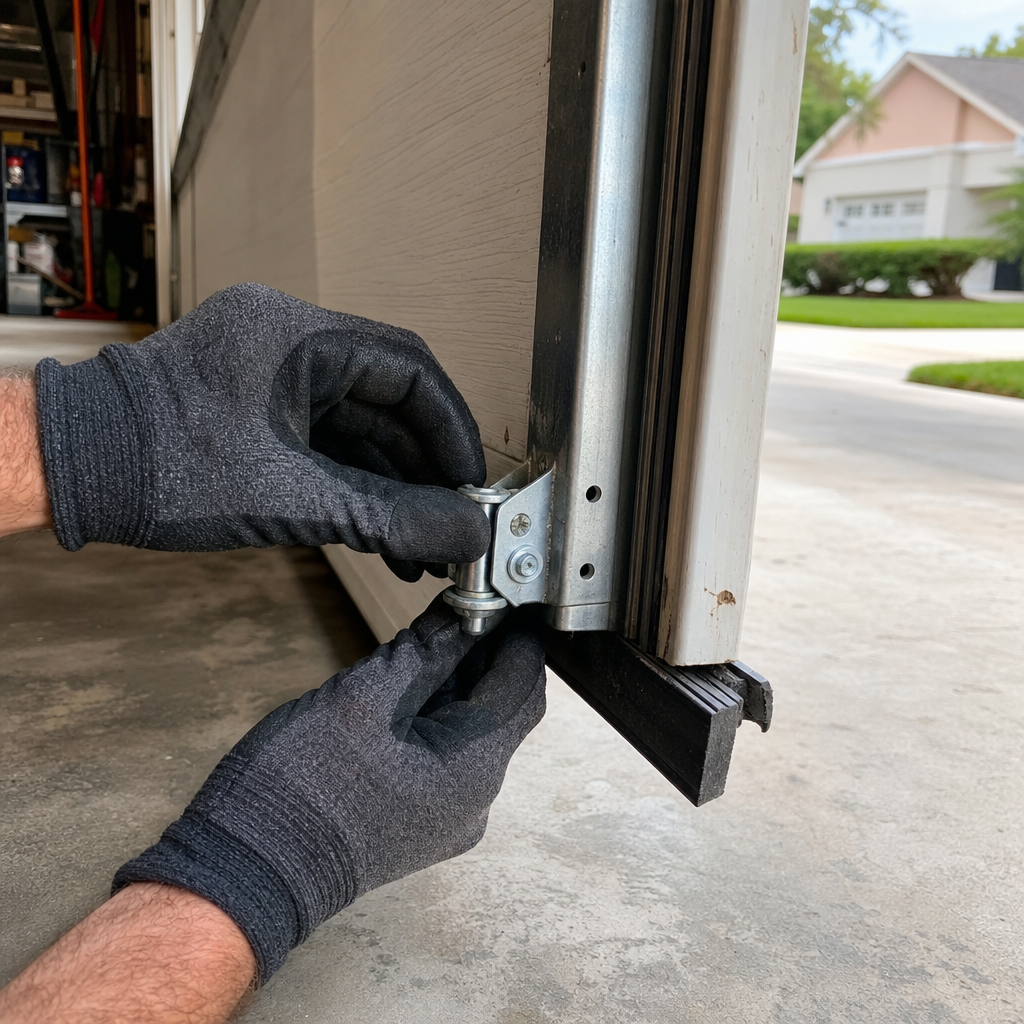
- Bottom seal condition. The rubber or vinyl bottom seal keeps wind-driven rain from pouring under the door. Inspect the full width for cracks, flattening, or sections that have pulled away from the retainer channel. A compromised seal on a single-car door costs roughly $40–$80 in material to replace; the water damage from a tropical downpour pouring under a failed seal costs orders of magnitude more.
- Emergency release cord test. Pull the red cord while the door is closed and confirm it disengages smoothly. Then manually lift the door to mid-travel and verify it stays up without dropping. A door that free-falls when manually released has a spring tension problem that needs professional attention before hurricane season — not during it. Do not attempt to adjust or replace torsion springs yourself; these components store extreme mechanical energy and require specialized tools and training to service safely.
Round out your April checklist by testing the auto-reverse safety feature, cleaning the photo-eye sensors with a dry cloth, and verifying your opener’s battery backup is charged if you have a Chamberlain or similar unit with that feature.
Wet Season (June–September): Humidity, Rust, and Heat Damage
Delray Beach averages roughly 60 inches of annual rainfall, with the majority concentrated between June and September. That’s not background context — that’s a maintenance driver. The wet season creates three distinct threats to your garage door system.
Drainage Channel Clearing
The bottom section of your garage door frame collects debris — leaves, sand, and the fine limestone grit that’s everywhere in South Florida. When that debris packs into the drainage channel along the threshold, it holds moisture against the door bottom and the slab edge. Check and clear this channel monthly during the wet season. A stiff brush and a hose take five minutes and prevent rot on wood doors and rust creep on steel bottom sections.
Rust Acceleration on Spring Ends
Torsion springs are cut to length during manufacturing, and those freshly cut ends — where the galvanizing doesn’t reach — are the first place rust takes hold in coastal South Florida. Salt air off the Atlantic accelerates the process noticeably in eastern Delray Beach neighborhoods like The Estuary and areas close to the Intracoastal. During the wet season, apply a light coat of silicone-based lubricant to the spring coils every six to eight weeks. Avoid WD-40 for this task — it’s a solvent, not a lubricant, and it strips the minimal corrosion protection that’s already there.
Swelling and Sticking in Wood Doors
If you have a solid wood or wood-composite door, summer humidity causes the panels to expand. A door that operates smoothly in January may drag on the floor or bind in the tracks by July. We cover the specific maintenance steps for wood doors in a dedicated section below.
Dry Season (October–March): Recalibration and Lubrication
Delray Beach’s dry season brings lower humidity, cooler nights, and a significant shift in how your garage door hardware behaves. Metal components that expanded across summer now contract — and that contraction exposes every lubrication gap, every worn roller, and every maladjusted opener force setting that the warmer months masked.
The single most neglected task at the start of dry season is recalibrating your opener’s force settings. When a steel door contracts by even a fraction of an inch in track diameter, the opener may read that as resistance and either slow down, reverse, or trigger an obstruction alarm it wouldn’t have in July. On a Genie screw-drive unit, this usually shows up as the door reversing on the way down without any physical obstruction. The fix is straightforward — most modern openers let you adjust up-force and down-force through the unit’s programming menu — but it’s genuinely something homeowners skip every fall because they don’t connect the seasonal temperature shift to the opener’s behavior.
Your dry-season maintenance checklist:
- Lubricate all hinges, roller stems, and the torsion spring coils with a white lithium grease or dedicated garage door lubricant. Apply sparingly — excess lubricant attracts the fine sand and limestone dust that’s abundant in South Florida.
- Inspect all rollers for flat spots or cracked nylon wheels. Cold contraction makes worn rollers noisier and more obvious — use this as a diagnostic window.
- Check cable tension visually. With the door closed, the cables running from the bottom brackets up to the drum should be taut and evenly tensioned. A slack or fraying cable is a professional repair — do not attempt to re-tension cables yourself, as they are under significant load even when the door is down.
- Test the door balance. Disconnect the opener (pull the release cord), manually lift the door to waist height, and let go. It should hold position within a few inches. If it drops or rockets upward, the spring tension needs professional adjustment.
- Wipe down the weather stripping on all four sides and inspect for brittleness. The dry season’s UV intensity in Delray Beach — even with lower temperatures — degrades vinyl and rubber faster than homeowners expect.
Documenting Your Door for Hurricane Season Insurance Claims
This is the section most maintenance guides skip entirely, and it’s genuinely useful for any Delray Beach homeowner carrying wind or hurricane coverage.
Insurance adjusters assess garage door damage based on the pre-storm condition of the door. If you don’t have documentation of the door’s pre-storm state, a claim for storm damage becomes a negotiation where the adjuster holds most of the cards. Here’s a practical documentation process that takes under 20 minutes:
- Photograph the door from the outside — full panel, close-up of the bottom seal, and both bottom corners where damage typically starts. Do this on a clear day in late April or early May each year.
- Photograph the interior hardware — springs, cables, tracks, and opener head. Focus on any pre-existing wear so it’s on record as pre-storm condition, not storm damage.
- Note the door’s model, brand, and approximate installation date on a text file saved with the photos. If you have a Clopay door, the model sticker is typically on the inside of the top panel. This information directly affects replacement cost valuation.
- Store the photos in cloud backup — not just on your phone. A storm that damages your garage door may also damage the device with your only copy of the photos.
- Re-photograph after any storm event and note the date. This before-and-after record is what makes a claim defensible.
After Hurricane season ends in November, do a post-season inspection even if the door seems fine. Track fasteners can back out from repeated pressure cycling during near-miss storm events without showing obvious damage. In Delray Beach’s western neighborhoods — areas that sometimes take the windier northern quadrant of passing systems — we see this kind of fastener fatigue show up in December or January as the door begins to vibrate or rattle at wind speeds that never bothered it before.
The Summer Habit That Shortens Your Opener’s Life
Here’s the local insight most generic guides don’t give you: running your garage door opener repeatedly while the garage is fully sealed on a hot South Florida summer afternoon is one of the fastest ways to shorten the motor’s service life.
An insulated garage in Delray Beach in July can reach 110–120°F when sealed. Every time you run the opener, the motor generates additional heat. Modern openers — including most current Chamberlain and Genie units — have thermal overload protection that shuts the motor down before it burns out, but repeatedly pushing the motor to thermal cutoff accelerates wear on the motor windings and the logic board capacitors. Homeowners who work from home and use the garage as a storage or hobby space, cycling the door six to ten times a day through peak summer heat, often see opener failures at the five-to-six-year mark instead of the ten-to-twelve-year mark.
The practical fix is simple: if you’re cycling the door frequently in summer, crack a door or window in the garage to allow some convective cooling. If your opener doesn’t have a built-in temperature sensor, consider one of the current-generation smart openers that logs cycle counts and temperature data — that information is genuinely useful for scheduling preventive replacement before a failure strands you.
Special Considerations for Wood and Wood-Composite Doors in South Florida
Wood and wood-composite doors remain popular in Delray Beach’s historic districts and in neighborhoods where the HOA requires a specific aesthetic. They’re beautiful — and they require meaningfully more attention in South Florida’s climate than a steel or fiberglass door would.
The core challenge is dimensional movement. Real wood expands in the wet season and contracts in the dry season, and that movement works against the door’s hardware, finish, and weatherstripping on a repeating annual cycle. Over several years, that cycling works fasteners loose, causes finish to crack and allow moisture penetration, and can warp individual panels enough to create binding or gap problems.
Maintenance priorities for wood doors in Delray Beach:
- Inspect and refinish the exterior face every two years at minimum. A failed exterior finish on a wood door in South Florida’s UV and humidity environment leads to delamination and rot significantly faster than it would in a drier climate.
- Check all panel joints in May before wet season. Any visible cracking at panel edges or joints should be sealed before the rains arrive.
- If the door begins to bind or drag in summer, do not force it through the opener. Confirm the tracks are clear, check that no individual panel has warped enough to contact the frame, and assess whether the bottom section is swollen against the threshold. A small amount of seasonal adjustment is normal; binding that requires force is a signal to call for an inspection.
- Consider whether a high-density fiberglass door — available through brands like Clopay or Amarr — would give you the wood aesthetic without the dimensional movement issue. In our experience working in Delray Beach for nearly two decades, this is a conversation worth having before a wood door reaches its second refinish cycle.
Common Mistakes to Avoid
- Using WD-40 as a garage door lubricant. WD-40 is a water displacer and light solvent, not a long-term lubricant. In Delray Beach’s salt air environment, applying it to springs and hinges leaves those surfaces more vulnerable to corrosion within weeks, not months. Use white lithium grease or a product specifically labeled for garage door components.
- Skipping the spring and cable inspection because “the door still works.” Torsion springs in South Florida’s coastal environment fail faster than their rated cycle count suggests because salt air accelerates corrosion at the uncoated cut ends. A spring that looks intact can have significant internal rust at its core. By the time it fails, it usually fails abruptly — often trapping a car in or out of the garage. Annual professional inspection of springs and cables is the correct interval in this climate.
- Power-washing the garage door tracks. A common impulse after storm season — homeowners power-wash the entire garage bay, including the tracks. High-pressure water blasts existing lubricant out of rollers and hinges and can drive grit into sealed bearing races. Wipe tracks clean with a rag; don’t blast them.
- Ignoring the bottom seal until it fails completely. In Delray Beach, a compromised bottom seal doesn’t just let in rain — it lets in the humidity gradient that drives the interior rusting process. Replacing a worn seal proactively costs a fraction of what it costs to address the rust and corrosion damage a full wet season of uncontrolled moisture infiltration causes.
- Deferring wind-load hardware inspection until after a storm warning. Florida’s emergency management community consistently notes that residential garage doors are among the most vulnerable structural openings during a hurricane. Hardware that was barely adequate under normal conditions can fail catastrophically under wind loading. The time to find loose lag screws and bent track braces is April, not when a storm is 48 hours out.
- Running the opener on manual after a power outage without checking the release mechanism first. After extended outages — common in Delray Beach during and after tropical events — the release lever can stick or the carriage can shift on the rail. Forcing a stuck release risks damaging the carriage or the rail itself. If the release doesn’t engage smoothly after an outage, call for a check before operating the door manually under the door’s full weight.
- Assuming a new-construction door is “maintenance-free.” Newer Delray Beach homes, particularly in developments built in the last decade, often ship with adequate but minimally specified garage door hardware. Wind-load ratings, spring cycle ratings, and roller quality vary widely by builder grade. A new door isn’t a free pass on annual inspection — it’s the beginning of a maintenance relationship, not the end of one.
When to Call a Professional
Some garage door maintenance genuinely belongs in the homeowner’s hands — lubricating hinges, clearing drainage channels, checking photo-eye alignment. But certain scenarios call for a trained technician, and recognizing the line matters.
Call a professional when: a torsion spring is broken or visibly corroded (spring replacement involves stored mechanical energy that can cause serious injury if mishandled); a cable has snapped or gone slack; the door drops or rockets upward during the balance test; the opener strains, reverses without cause, or trips thermal overload repeatedly; track damage is visible after a storm event; or the emergency release won’t disengage smoothly. These aren’t judgment calls — they’re situations where the risk of a DIY approach is genuine and significant.
For Garage Door Repair in Delray Beach, Patriot Garage Door Solutions offers free estimates — call (754) 240-2374 and you’ll reach Henry Johnson directly, not a dispatch center.
Frequently Asked Questions
In Delray Beach’s salt-air and high-humidity environment, lubricate springs, hinges, and roller stems every three to four months — more frequently than the six-month interval most manuals recommend, because coastal conditions accelerate the breakdown of lubricant films. Use white lithium grease or a dedicated garage door lubricant, and apply a light coat rather than saturating the components. Call (754) 240-2374 if you’d like Henry to walk you through the specific products that hold up best in South Florida conditions.
It can. Most manufacturer warranties require that the door has been maintained according to the service schedule and that wind-load hardware specifications for the installation location have been met. Doors installed in Delray Beach’s wind zone without the correct wind-load rating or missing required bracing components may have warranty claims denied after storm damage. Document your door’s wind-load compliance as part of your pre-season insurance documentation process.
A hurricane-ready garage door in Delray Beach should have a Florida Product Approval number on its specification label, correctly installed horizontal and vertical track bracing rated for the local design wind speed, a bottom seal in full contact with the threshold, and no loose or missing hardware at the track brackets and lag anchor points. Testing means physically inspecting each of these — not just pressing the button and watching the door move. If you’re unsure of your door’s wind rating, that label inspection is the starting point; a professional can pull the product approval record from the Florida Building Commission database using that number.
This is a very common complaint in Delray Beach from October through February, and the cause is almost always seasonal contraction. When steel tracks and door sections contract in cooler weather, the opener senses additional resistance on the down-travel and interprets it as an obstruction. The fix is adjusting the opener’s down-force sensitivity setting — a five-minute procedure on most Chamberlain and Genie units once you locate the force adjustment controls. If the reversal happens at the same point in the travel every time, it may also indicate a track alignment issue that developed over summer. Call (754) 240-2374 for a free assessment.
Repair makes sense when the hardware — springs, cables, rollers, opener — is the issue and the door panels themselves are structurally sound. Replacement becomes the better investment when panels are cracked or badly rusted, when the door’s wind-load rating doesn’t meet current Florida Building Code requirements for your zone, or when the cumulative cost of multiple repairs approaches the cost of a new installation. For Delray Beach homeowners specifically, a steel or fiberglass door from a brand like Clopay or Amarr rated for South Florida’s wind zone is often a smarter long-term choice than repeatedly repairing an aging wood door. Visit our Garage Door Installation in Delray Beach page to see current options, or call (754) 240-2374 for an honest assessment — Henry will tell you straight whether a repair gets you there or whether a new door is the right answer.
Yes — adding a garage door opener to an existing manual door is straightforward in most cases, provided the door is in good mechanical condition and properly balanced. A door with worn springs or a balance problem will stress any new opener motor immediately, so the correct sequence is to address mechanical issues first, then install the opener. Brands like Chamberlain and Genie offer a wide range of units suited to different door weights and sizes, including models with battery backup that’s particularly valuable in Delray Beach during storm-season power outages. See our Garage Door Opener in Delray Beach page for current options, or call (754) 240-2374 to discuss which unit fits your door and your setup.
The Bottom Line
Garage door maintenance in Delray Beach runs on a three-phase clock — pre-storm prep in April and May, wet-season vigilance from June through September, and dry-season recalibration from October through March. The homeowners who avoid expensive failures are the ones who treat each phase as its own task list rather than waiting for something to break. Salt air, tropical humidity, UV intensity, and seasonal metal contraction are the four forces working against your door year-round in South Florida. Stay ahead of them with targeted lubrication, seal inspections, opener force recalibration, and wind-load hardware checks, and your door will give you reliable service well past any manufacturer’s estimate. When something falls outside the homeowner’s scope, Patriot Garage Door Solutions Delray Beach is one call away.
Ready to get your garage door on the right maintenance schedule? Call Henry Johnson directly at (754) 240-2374 for a free estimate. With 19 years serving Delray Beach and a 4.9-star average across 345 verified reviews, Patriot Garage Door Solutions brings the kind of hands-on knowledge that only comes from seeing nearly every garage door problem this climate can produce — and fixing it the right way the first time.
Written by Henry Johnson, Owner & Lead Technician at Patriot Garage Door Solutions Delray Beach, serving Delray Beach since 2007.