Last updated June 30, 2026
Garage Door Permits, Codes & Inspections in FL: What You Need to Know
Most homeowners assume a garage door swap is a straightforward home improvement — order a door, have it installed, move on. In Florida, that assumption has derailed real estate closings, voided homeowner’s insurance claims, and triggered costly retroactive permitting battles. In Palm Beach County alone, unpermitted garage door replacements have become one of the more common flag items on pre-sale home inspections, particularly in established neighborhoods like Tropic Isle and Lake Ida here in Delray Beach. This guide walks you through exactly when a permit is required, what Florida’s product approval system demands, how the inspection process works locally, and what to do if a previous owner took shortcuts. By the end, you’ll know more about this subject than most contractors working in your zip code.
Quick Answer
In Florida, a building permit is required any time a garage door is fully replaced — meaning the door panels, tracks, and hardware are swapped out — because it constitutes a structural alteration under the Florida Building Code. Simple repairs such as spring replacement, cable repair, or opener service do not require a permit. In Palm Beach County, that replacement door must also carry a valid Florida Product Approval (FPA) number confirming it meets wind-load requirements for the local High-Velocity Hurricane Zone designation.
Table of Contents
- When Does a Garage Door Replacement Require a Permit in Florida?
- Florida Product Approval (FPA): The Wind-Load Rule Every Homeowner Should Know
- How the Inspection Process Works in Delray Beach
- What Happens If the Previous Owner Skipped the Permit?
- How to Ask a Contractor for Proper Permit Documentation — Before Work Starts
- High-Velocity Hurricane Zone Explained: Why Delray Beach Doors Face Stricter Standards
- Common Mistakes to Avoid
- When to Call a Professional
- Frequently Asked Questions
- The Bottom Line
When Does a Garage Door Replacement Require a Permit in Florida?
The Florida Building Code draws a clear — if often misunderstood — line between a repair and a replacement. Here’s the practical version of that line:
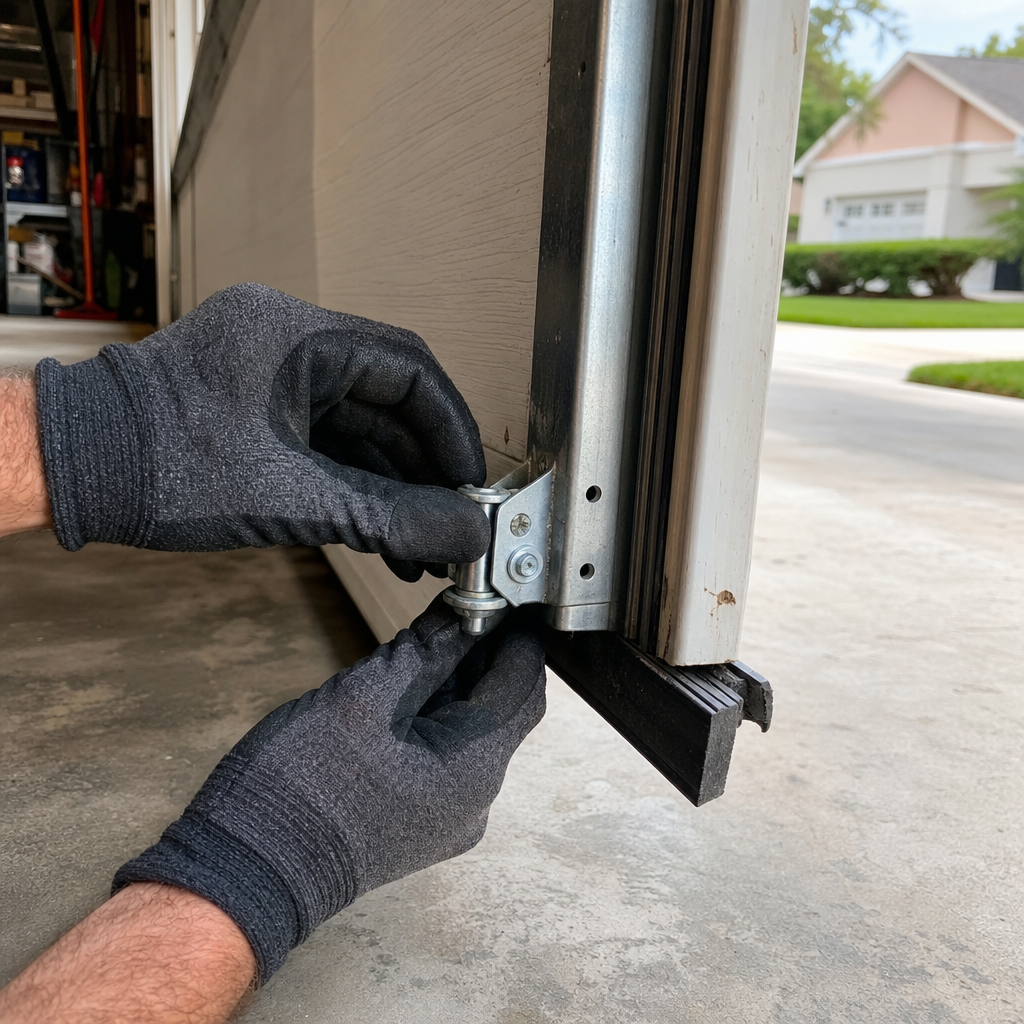
No permit required: Work that maintains or restores a component of an existing door system without altering its structural configuration. This includes torsion spring replacement, broken cable repair, roller and hinge swaps, opener installation or replacement, and weather seal replacement. These are maintenance tasks, even when they’re expensive or technically involved.
Permit required: Any work that involves removing and replacing the door panels themselves — whether you’re swapping a single-panel door for a sectional, replacing a deteriorated wood door with an insulated steel model, or upgrading to an impact-rated door. The moment the door itself comes off the building and a new one goes on, you are performing a structural modification under Florida Building Code Section 105.1, and a permit must be pulled before work begins.
Palm Beach County’s Building Division interprets this consistently: full door replacement equals a building permit, no exceptions. The permit must be obtained by a licensed contractor — a homeowner owner-builder permit is technically available for single-family residences, but most title companies and lenders treat owner-builder permits with heightened scrutiny during a sale. We’ve worked in Delray Beach long enough — 19 years now — to have seen both approaches, and the contractor-pulled permit is always cleaner when it comes time to sell.
One nuance worth knowing: replacing just the bottom panel of a sectional door typically does not require a permit in Palm Beach County, because you’re not replacing the door assembly as a whole. But if you’re replacing three or more sections, inspectors may treat it as a full replacement. When in doubt, call the Building Division at (561) 822-1700 before any work is scheduled.
Florida Product Approval (FPA): The Wind-Load Rule Every Homeowner Should Know
Florida operates one of the most stringent building product approval systems in the country, and garage doors sit squarely in its scope. The Florida Product Approval (FPA) system, administered through the Florida Building Commission, requires that any garage door installed as a replacement in the state carry a valid FPA number demonstrating it has been tested to withstand specific wind pressures.
This isn’t optional, and it isn’t bureaucratic paperwork for its own sake. South Florida’s exposure to hurricane-force winds is real and annual. An FPA-approved door has been independently tested and certified to meet the wind-load requirements for its intended installation zone. An unapproved door — even one from a recognizable brand — cannot legally be installed as a replacement in Florida.
What this means practically:
- Every replacement door must have an FPA number listed in the permit documentation.
- The FPA number is tied to a specific door model, size, and wind-load rating — it’s not transferable between products.
- Doors approved for lower wind zones in northern states are not automatically approved for South Florida installations.
- Brands like Amarr and Wayne Dalton both carry FPA-certified product lines for Florida installations, but the specific model you choose must be verified — not just the brand.
- If an inspector finds that a door was installed without a corresponding FPA-approved product, the installation fails, full stop.
When we pull a permit for a Garage Door Installation in Delray Beach, the FPA number goes into the permit application from the start. It’s not an afterthought — it’s part of what makes the permit approvable in the first place.
How the Inspection Process Works in Delray Beach
Once a permit is pulled for a garage door replacement in Delray Beach, the inspection process follows a predictable sequence. Here’s how it typically unfolds:
- Permit application submitted. The licensed contractor submits the permit application to the City of Delray Beach Building & Permit Division, including the FPA product approval documentation and the door specifications. Applications can be submitted online through the city’s permitting portal.
- Permit issued. For straightforward garage door replacements, permits are typically issued within two to five business days, though timelines can extend during high-volume periods or when documentation is incomplete on the first submission.
- Installation performed. Work begins only after the permit is in hand. The permit must be posted or available on-site during installation.
- Inspection requested. After installation is complete, the contractor calls in for a final inspection. Delray Beach uses an automated scheduling system — inspections are typically scheduled within one to three business days of the request.
- Inspector visits the site. The inspector will verify that the door is the FPA-approved model listed in the permit, that installation conforms to the manufacturer’s approved installation instructions (which are part of the FPA file), that anchor hardware meets the specified requirements, and that the door operates correctly.
- Permit closed. If the inspection passes, the permit is closed and the record becomes part of the property’s permit history — visible to any future buyer, inspector, or title company.
In our experience working in Delray Beach, the inspection itself is rarely the hard part. Most failures happen upstream: wrong product, missing documentation, or work starting before the permit was approved. Get those details right on the front end and the inspection is usually a formality.
What Happens If the Previous Owner Skipped the Permit?
This scenario is more common than most buyers realize, and it’s become a sharper issue as title companies and real estate attorneys have grown more diligent about flagging permit history gaps. If you’re selling a Delray Beach home — or you’ve just purchased one — and a garage door was replaced without a permit, here’s the realistic path forward.
The retroactive permit process in Palm Beach County looks like this:
- Confirm the unpermitted work. Pull the property’s permit history through the City of Delray Beach or Palm Beach County’s online portal. If there’s a garage door replacement on the property with no corresponding permit, that’s the gap you need to address.
- Engage a licensed contractor. A retroactive (or “after-the-fact”) permit must be pulled by a licensed contractor. You’ll need documentation of what was installed — model number, FPA approval number, and installation date if known.
- Submit the permit application. The application is the same as a standard permit, but you’ll note that the work has already been completed. Palm Beach County charges a standard permit fee plus an after-the-fact surcharge — expect to pay roughly 1.5 to 2 times the standard permit fee, which for a garage door typically runs between $75 and $175 depending on the scope.
- Schedule the inspection. An inspector will visit the property to verify the existing installation. If the door was installed correctly and is an FPA-approved product, the inspection is likely to pass. If the door is not FPA-approved or was installed incorrectly, you may face a requirement to replace it — which is where costs escalate significantly.
- Receive permit closure. Once the inspection passes, the permit is closed and the property’s record is clean.
The worst-case scenario: a non-FPA door was installed, it fails inspection, and it has to come out. We’ve helped Delray Beach homeowners navigate exactly this situation before a closing — it’s stressful, but it’s solvable when you have the right contractor and enough lead time.
How to Ask a Contractor for Proper Permit Documentation — Before Work Starts
The single most protective thing a homeowner can do is ask for permit documentation before signing any contract for a full door replacement. Here’s what a legitimate permit receipt and documentation package looks like, and the questions to ask upfront:
Before work begins, ask your contractor for:
- Confirmation that they will pull the permit — not that you should pull an owner-builder permit
- The specific door model being installed and its Florida Product Approval (FPA) number (searchable at floridabuilding.org/pr)
- A copy of the permit application once submitted, showing the permit number
- A timeline for when the permit will be approved before installation begins
After work is complete, verify:
- That the final inspection was called in and passed — ask for the closed permit documentation
- That the permit record is visible in the city or county’s online system under your property address
- That you receive copies of all documentation for your home file
A contractor who hesitates at any of these questions is telling you something important. When Henry Johnson pulls a permit for a Garage Door Repair in Delray Beach or a full replacement, the homeowner gets documentation at every stage. That’s not a special service — it’s the baseline standard for work done right.
High-Velocity Hurricane Zone Explained: Why Delray Beach Doors Face Stricter Standards
Florida’s building code designates certain counties as High-Velocity Hurricane Zones (HVHZ) — areas where the combination of storm frequency and intensity demands elevated structural standards for all building components, including garage doors. Palm Beach County sits within the HVHZ designation, which means every garage door replacement in Delray Beach is subject to the most stringent wind-resistance requirements in the state.
What does this mean for the door you choose?
- The door must be tested and approved to resist both positive pressure (wind pushing in) and negative pressure (wind pulling out) at the design wind speeds for your specific location.
- The door’s track system, horizontal bracing, and hardware must be installed per the manufacturer’s HVHZ-specific installation instructions — which often differ from the standard installation guide.
- End stiles, horizontal bracing struts, and attachment points are all specified in the FPA file and are subject to inspector review.
- Some older door models that were FPA-approved years ago may have had their approvals expire or be superseded — a current, valid approval must be confirmed at the time of installation.
In practical terms, this is why you can’t just order a garage door from a big-box retailer and have anyone install it in Delray Beach. The door might look identical to a Florida-approved model, but without the documented FPA certification and the HVHZ-compliant installation, it won’t pass inspection — and it won’t protect your home the way it should when a storm comes through.
When we specify a door for a Delray Beach installation — whether it’s an Amarr insulated steel section or a Wayne Dalton raised-panel design — the first thing we verify is that the specific model carries current FPA approval for the wind-load conditions at the installation address. That step happens before anything is ordered.
Common Mistakes to Avoid
- Letting a contractor start work before the permit is issued. “We’ll pull it while we’re installing” is not how permitting works in Palm Beach County — and it’s one of the most common ways homeowners end up with a retroactive permitting headache later. Permits must be issued before installation begins, period.
- Assuming the same door you liked at a showroom in Georgia is legal in Florida. FPA approval is Florida-specific. A beautiful, well-reviewed door model from a mid-Atlantic or Midwestern market may not have been tested or approved for Florida’s wind-load requirements. Always verify the FPA number for the exact model being quoted.
- Taking the contractor’s word on FPA approval without verifying. The Florida Building Commission’s product approval database is publicly searchable at floridabuilding.org/pr. It takes two minutes to confirm that the model number and FPA number match. Don’t skip this step.
- Skipping the permit because the work “looked like a repair.” In the Bexley Park and Rainberry Bay neighborhoods of Delray Beach, we’ve seen full door replacements described as “panel repairs” on invoices — an innocent mistake at best, a deliberate misclassification at worst. If the entire door came off the building, it’s a replacement.
- Failing to request the closed permit documentation after the inspection. The permit is only useful to you as a property record if it’s been closed after a passing inspection. An open permit on your property can be just as problematic at closing as no permit at all.
- Pulling an owner-builder permit to save money before a sale. Owner-builder permits are legal in Florida for single-family residences, but they signal to buyers, lenders, and title companies that a licensed contractor did not supervise the work — which often triggers additional scrutiny and can stall closings in Delray Beach’s active real estate market.
- Choosing a door based on price alone without confirming it meets HVHZ requirements. A door that is not rated for Palm Beach County’s wind loads is not a cost savings — it’s a liability. When a storm tests it, the consequences aren’t paperwork; they’re structural.
When to Call a Professional
If you’re planning a full garage door replacement, dealing with a pre-sale permit question, or navigating a retroactive permit for work a previous owner did without documentation, this is not a DIY project — it’s a licensed contractor situation. The FPA documentation requirements, permit applications, and inspection scheduling all require a contractor of record. Attempting to manage this as a homeowner without proper licensing puts the permit validity in question and can complicate the very problem you’re trying to solve.
Spring and cable work is a separate matter worth flagging: high-tension torsion springs store significant mechanical energy and should only be adjusted or replaced by a trained technician. We’ve seen serious injuries result from DIY spring work — it’s one area where the risk genuinely isn’t worth taking on yourself.
For anything involving a full replacement, a permit question, or an emergency door failure in Delray Beach, Patriot Garage Door Solutions Delray Beach offers free estimates — call Henry directly at (754) 240-2374. You’ll talk to the person who will actually do the work.
Frequently Asked Questions
Yes — a full garage door replacement requires a building permit in Florida under the Florida Building Code. This applies throughout Palm Beach County, including Delray Beach. Simple repairs such as spring replacement, opener service, or cable repair do not require a permit. Call (754) 240-2374 if you’re unsure whether your project qualifies as a repair or replacement — we can tell you in one conversation.
A Florida Product Approval (FPA) number is a state-issued certification confirming that a specific garage door model has been independently tested and meets Florida’s wind-load resistance requirements. Every garage door installed as a replacement in Florida must have a valid FPA number on file as part of the permit documentation. Without it, the permit application will not be approved and the installation will fail inspection.
For a straightforward residential garage door replacement with complete documentation, permits are typically issued within two to five business days through the City of Delray Beach Building & Permit Division. Incomplete applications — missing FPA numbers, wrong product specifications, or missing contractor licensing information — are the most common cause of delays. A contractor who submits a complete application the first time almost always avoids the second-round delays.
An unpermitted garage door replacement becomes the new owner’s responsibility once the property transfers. You’ll need to pursue a retroactive (after-the-fact) permit, which involves hiring a licensed contractor, verifying that the existing door is an FPA-approved model, and scheduling a building inspection. If the door fails inspection — typically because it isn’t FPA-approved or was installed incorrectly — you may be required to replace it. Addressing this before closing, not after, is strongly advisable in Delray Beach’s current real estate market.
Technically, yes — Florida allows homeowners to pull owner-builder permits for work on their primary residence. However, most title companies and lenders flag owner-builder permits as a risk factor during real estate transactions because they indicate no licensed contractor supervised the work. For a Delray Beach home you intend to sell, a contractor-pulled permit is always the cleaner record. Call (754) 240-2374 for a free estimate on properly permitted installation.
No — replacing a Garage Door Opener in Delray Beach is classified as a mechanical service or repair, not a structural modification, and does not require a building permit under the Florida Building Code. The permit requirement applies specifically to the door panels and assembly. If you’re replacing both the door and the opener at the same time, the permit covers the door; the opener is included in the scope of the permitted work without a separate application.
The Bottom Line
Florida’s garage door permitting rules exist because a garage door in Palm Beach County isn’t just a convenience feature — it’s a wind-rated structural component of your home. The threshold that triggers a permit is clear once you understand it: full replacement requires one, repairs don’t. Every replacement door must carry current Florida Product Approval for HVHZ conditions, the permit must be pulled before work begins, and the final inspection must close the record. Getting this right protects your home in a storm, keeps your insurance claim defensible, and keeps your closing clean when it’s time to sell. In Delray Beach, cutting these corners rarely saves money — it just delays the cost.
Key Takeaways:
- Full door replacement = permit required. Repairs (springs, cables, openers) = no permit required.
- Every replacement door in Florida needs a valid FPA number; Palm Beach County is HVHZ — the strictest tier.
- The permit must be issued before installation begins — not during or after.
- Retroactive permits are available but costlier, and they can fail if the installed door isn’t FPA-approved.
- Always request closed permit documentation after inspection — an open permit is a liability at closing.
- Ask your contractor for the FPA number and permit confirmation before you sign anything.
Henry Johnson and the team at Patriot Garage Door Solutions Delray Beach handle permitted installations throughout Delray Beach and the surrounding area. With 19 years in the trade and 345 verified reviews averaging 4.9 stars, we’ve navigated every variation of this process — straightforward replacements, retroactive permits, HVHZ-specific product selection, and everything between. Call (754) 240-2374 for a free estimate, and you’ll talk directly to Henry — the person who will actually show up, pull the permit, and get the door right.
Written by Henry Johnson, Owner & Lead Technician at Patriot Garage Door Solutions Delray Beach, serving Delray Beach since 2007.